CHOOSEBusiness workflows
Jev for AI Routing

Sunil Mehta@Sunilmehta_695
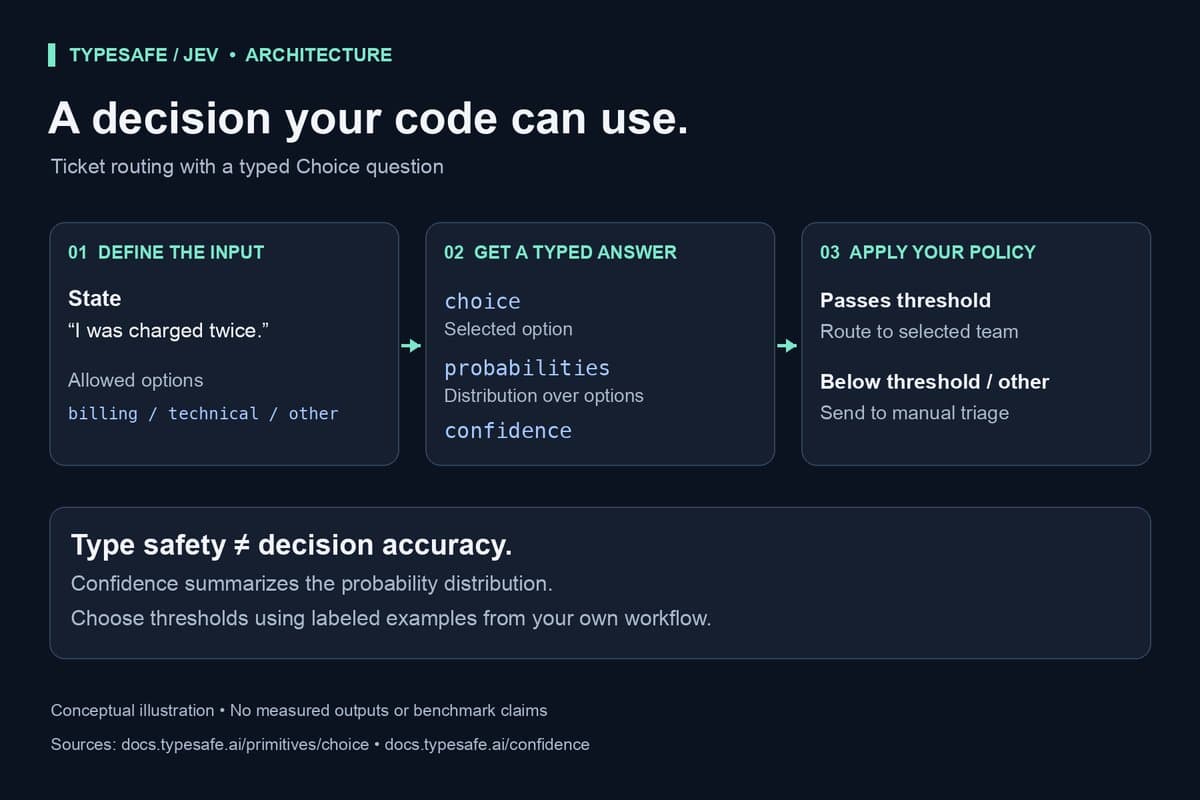
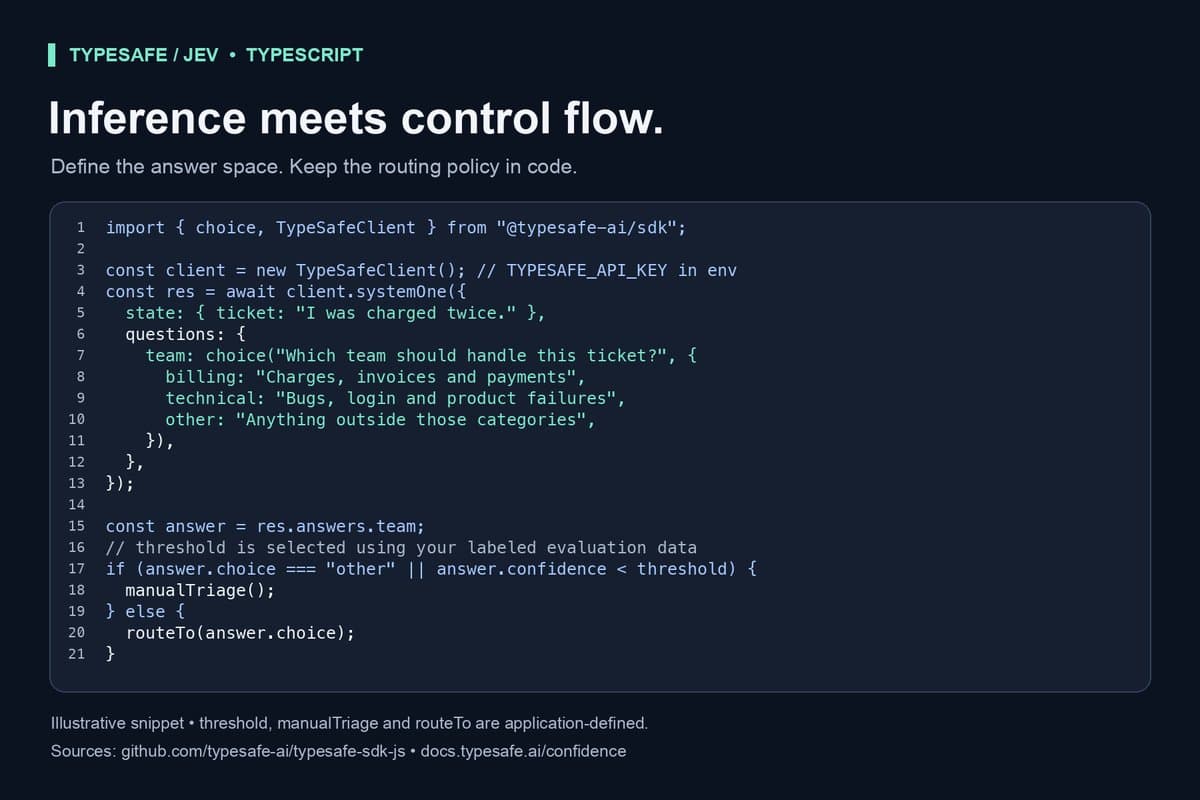
Jev is an AI routing mechanism that takes state and typed questions to produce structured answers, enabling explicit control flow and defined fallbacks for applications.
TakeI have access to @typesafeai's Jev, and the interface is what caught my attention: state + typed questions → structured answers For ticket routing, define the possible destinations: billing, technical, other.
An AI router shouldn't need a paragraph. It needs a decision your code can use.
I have access to @typesafeai's Jev, and the interface is what caught my attention:
state + typed questions → structured answers
For ticket routing, define the possible destinations: billing, technical, other. A Choice answer gives you:
• choice: the selected option
• probabilities: the distribution over your options
• confidence: a summary of how concentrated that distribution is
Then the application owns the policy:
if (answer.choice === "other" || answer.confidence < threshold) {
manualTriage();
} else {
routeTo(answer.choice);
}
The threshold is something you evaluate on labeled tickets from your own workflow. A confidence score of 0.9 is not automatically a 90% guarantee of correctness.
You can also ask multiple independent questions against the same state in one call, then combine their answers in code.
That's the design idea I find interesting: put model judgments inside explicit control flow, with a defined fallback.
Type safety ≠ decision accuracy. Measure both routing quality and how often the system sends work to review.
The images illustrate the architecture and a TypeScript integration; they are not benchmark results.
Where would you try this first: support triage, intent routing, or document classification?
Docs: docs.typesafe.ai/introduction
Confidence: docs.typesafe.ai/confidence