SCOREData & productivity
Simple Jev Project

zast@zast57
The Simple Jev Project offers a faster and more reliable method for classifying data by directly reading next-token logits instead of generating text tokens, achieving near-identical classification results to cloud APIs with significantly lower latency and no parsing risk.
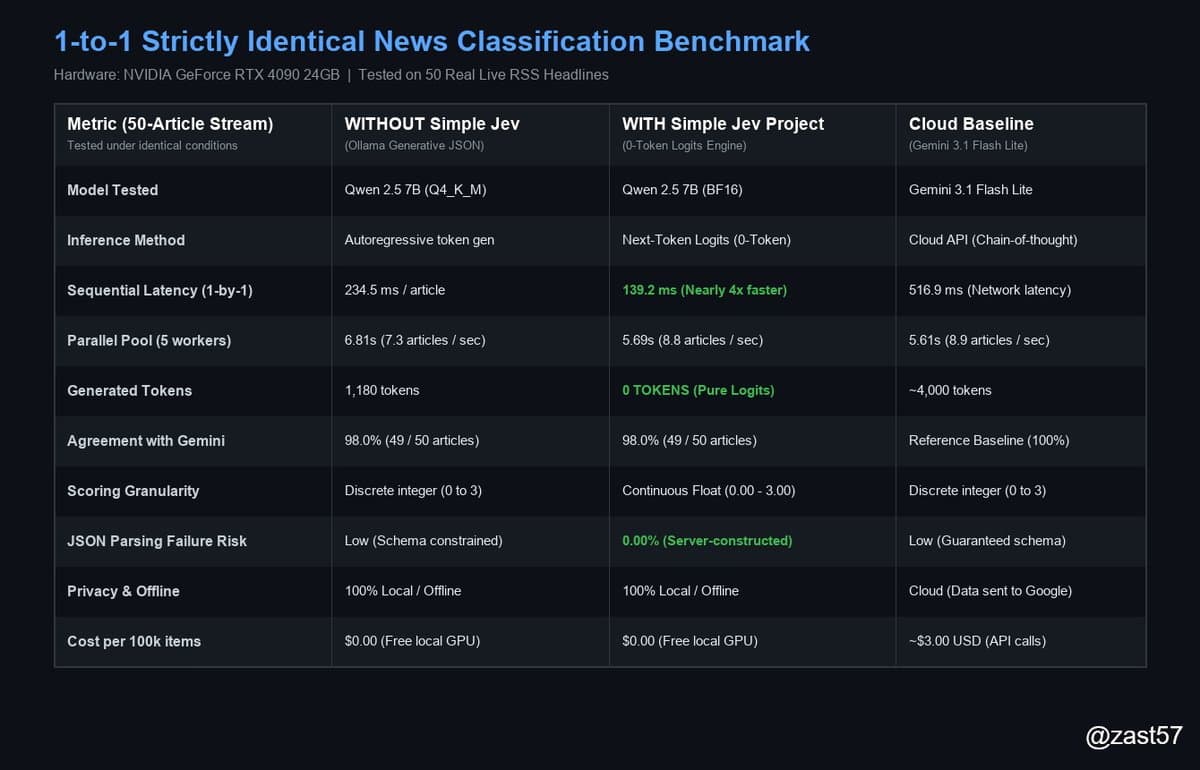
🚀 Stop generating JSON tokens for classification! We just ran an exhaustive, strictly identical benchmark on 50 real-world news articles comparing @FeatherlessAI 's Simple Jev Project against traditional generative LLMs and Cloud APIsy (see my benchmark table 📊).
When curating high-volume RSS feeds daily, asking an LLM to generate JSON tokens ("category", "score", "keep") feels natural—but autoregressive text decoding is actually the wrong tool for classification.
We tested a full live stream of 50 real unseen headlines across AI, tech, gaming, cinema, and world news under strictly identical conditions on an NVIDIA GeForce RTX 4090:
1️⃣ WITHOUT Simple Jev (Ollama Generative JSON - Qwen 2.5 7B)
2️⃣ WITH Simple Jev Project (0-Token Logits Engine - Qwen 2.5 7B)
3️⃣ Cloud Baseline (Google Gemini 3.1 Flash Lite API)
Key findings:
⚡ Pure Latency: Simple Jev processes items in 139ms—nearly 4x faster than Google Cloud (517ms) and 40% faster than local generative JSON (235ms).
🚀 Parallel Throughput: With 5 concurrent workers, Simple Jev matches Google Cloud's cluster speed (5.69s vs 5.61s for all 50 items) while running 100% offline on a single local GPU.
🎯 Zero Tokens: Pure single forward pass. It reads next-token logits directly (0 output tokens generated).
🧠 98% Decision Agreement: Simple Jev matched Gemini 3.1 Flash Lite classifications on 49/50 articles while providing continuous float scores (e.g. 0.00003/3 on off-topic noise).
🛡️ 0.00% Parsing Risk: The JSON response is constructed deterministically by the Python runtime from the logit tensors.
Huge shoutout to the team behind the Simple Jev Project !
You solved one of the biggest bottlenecks in local AI data pipelines. 👏
Related builds